Posted: April 5th, 2012 | Author: David Lutes | Filed under: Uncategorized | No Comments »
“We do not merely want to see beauty, though, God knows, even that is bounty enough. We want something else which can hardly be put into words – to be united with the beauty we see, to pass into it, to receive it into ourselves, to bathe in it, to become part of it.”
- C. S. Lewis, The Weight of Glory
One of the formative moments in my life as a Christian artist occurred quite unexpectedly, and without musical accompaniment, in the frigid, early hours of December 16th, 2007.
The late Fall moon had set, and I stood, rooted, in the backyard of our old house gazing up at the clearest night sky I’d ever seen in Austin – a sky only occasionally obscured by my steam-cloud breath and the swaying, silhouetted branches of our ash trees. It was a remarkable moment of calm and clarity – remarkable because my wife, Carolyn, and I had spent the preceding few hours perched breathlessly (she, from exertion; me, from addled excitement) around our coffee table, timing her contractions, knowing that in just a few unforgettable hours we would meet our daughter, Ruby.
As Carolyn’s contractions quickened, so did my pulse, and my anxious anticipation begot a flurry of restless, compulsive activity. I checked and re-checked our bags and loaded them (with a strange attention to placement) into the car, turned off lights, locked doors, adjusted the thermostat, examined my clothing choice (Does this shirt say, “competent birthing coach and responsible husband”?), checked for non-existent curling irons that might be plugged in; oh, and the camera battery (check); oh, right, and the bed needs making…I distractedly stacked pillows, readjusted the thermostat, checked the…wait, I remembered, we have two dogs – two dogs who have been patiently following me from room to room for the past hour. Yes, though they don’t share in our excitement, they do share in our need to pee regularly.
So, to speed up their bathroom proceedings (and keep them from cornering anything nocturnal and/or rabid), I slipped on my jacket and followed them out of the back door, stepping unprepared into the icy, pre-dawn stillness of our yard and….Whoa. There, amid my momentary distractions, nagging worries, and the furtive rustlings of dogs who may or may not be treeing a possum, something had been waiting…
The black, velvet blanket of sky embroidered with a billion sparkling diamonds. The chalk-water arc of the Milky Way, traced across the night sky as if by the hand of a child delightedly discovering watercolors in a rain puddle. The bracing, icy whisper of wind raising the thrum and throb of my heart. And, just inside my quiet house, a tiny body alive inside my wife, fearfully and wonderfully made, mysteriously being called at that moment to pass through water into life, even as her father was being called to be still and look…It was a sudden onrush of beauty, too much to take in. It was as if I was unaccountably miles and miles tall, my head in lower orbit, gliding through the heavens, and I could look down and see the turning of the Earth, moving us inexorably toward dawn – this dawn, out of every dawn in history – the one chosen for the birth of our daughter. The sun would rise on this very day, and we would be parents.This is the day that the Lord has made. Let us rejoice and be glad in it.
The Great I Am. The Creator of the Rolling Spheres. The Turner of this Earth. The One Who spoke these billions of unimaginably distant galaxies and stars into existence…this very Creator God made this day and created Ruby, as He created everything. Beautifully. Artfully. Even before we knew of her, he spoke into Carolyn and spoke Ruby into being, knitting the tiniest of creases on her palms and numbering the hairs on her head. As it was in the beginning, is now and ever shall be… And, why? Why did He pull me up out of my distracted self and direct my gaze to His creation, both big and small?…Scenes from my life began to flicker in front of my eyes…And why had He saved me and called me to meditate on His Word all these years and get married and be a lawyer and then not be a lawyer and write songs and be a dad and lead worship and…and? Why? The answer came with force. My soul welled up. This sky, this birth, our lives, our songs – signposts of His greater glory. He’s bringing Himself glory. Hallelujah. Amen and Amen.
I wasn’t overcome by all of this so that I might worship the stars or my baby or my laboring wife or my music. These were created to be glorious and arresting in order to stop me in my tracks, reorient my eyes and heart, and point me to their Creator - that He may be glorified. It was an unforgettable reminder that we all live, breathe, work, create, and love in reflection of the glory and love of our Creator. And, in soaking in His Word and living out our Gospel lives in Christ, He enables us to do all of these things gloriously, as acts of worship. He also calls us to daily seek out His created signposts to Himself and encourage and nurture the creation of such by others to deepen our understanding, knowledge, and love of Jesus. That’s what I was so vividly convicted of right before I became a dad. That’s why I love being a musician and leading our body in worship. That’s why I love getting to know other artists.
Thankfully, our beautiful, artful Creator God provides such signposts both in His creation and by creating and gifting artists who can reflect His glory and point us to Himself. Some are obvious to us in our gathered worship – pastors, musicians, and other servant-artists offering sermons, songs, and prayers, respectively.
Others serve in more subtle ways yet nonetheless point us weekly to Jesus, if we look. Visual artists offer the “images” of gathered worship through the weaving of robes and stoles, the crafting of stained glass and crosses, the designing of architecture, and the rendering of liturgical art. From Cary Tobleman’s needle-pointing on Tim’s stole to the ubiquitous crown of thorns on our liturgy to Zack Williamson’s communion ware, the visual art in our worship, like our sermons, songs, and prayers, help us to know Jesus and glorify God.
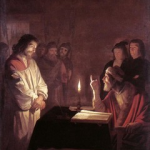
We’re blessed this week to add to these existing visual elements of our worship by including two images in our Good Friday and Easter liturgies, respectively. Each were graciously provided by artist and All Saints member, Sonya Berg Menges, and serve as arresting, worshipful signposts, reflecting upon Christ’s Crucifixion on Good Friday and His Resurrection on Easter. Both also do so in ways that a song or sermon would struggle to do. I encourage you to use them as you would the printed words in our liturgy, as a means of preparing your hearts for worship.
Sonya’s images will be accompanied by a small display of her work in the lobby at St. Gabriel’s and followed in a few weeks by a gallery showing of more of Sonya’s work at Hill House. You can read more from Sonya about her art below.
For more on the need for art and artists in worship, I highly recommend this artful article by Tim Keller: http://www.faithandwork.org/whyweneedartists
- David Lutes
Posted: April 5th, 2012 | Author: Sonya Berg Menges | Filed under: Uncategorized | 1 Comment »
The top of the clock tower in the center of town was my favorite spot for inspiration and prayer during the semester I spent in Orvieto, Italy. From the highest point in the quaint medieval city I watched the sunset gleam off the cathedral façade as it towered over the rolling hills of the Tuscan landscape. I felt the residual warmth of the orange volcanic rock with which the city was built, and watched as flocks of sparrows collectively danced and swooped down narrow alleys. It was within the beauty of Orvieto that I first experienced a real, tangible interaction of my work and faith.

Jodi Vermulen and Sonya Berg working in Orvieto, Italy, 2003
That fall I lived in a working convent, helped the nuns wash dishes after home cooked meals, and daily recited the Lord’s Prayer in Italian. Our classroom was a mimic of a Renaissance artist’s workshop where we helped artist and Gordon professor Bruce Herman with a large series of paintings. Bruce approached his work with fervent contemplation, and invited each of us to join his practice of singing and praying while working.
I was one of a few students charged with gilding two large wood panels with silver leaf. This preparation was a meticulous labor of love: the surface of the panel had to be perfectly smooth because the silver leaf would reveal the slightest blemish. Then using handmade glue and careful slow precision, we covered the panels with hundreds of extremely delicate (and costly) pages of silver.
Through hours of careful toil I understood the significance of using materials with inherent and perceived value. I learned of the importance of the working practice as well as the result. Silver leaf can signify wealth, status, and royalty and using it can be a contemplative process. While preparing those panels I participated in a sacrificial and redemptive experience: we were laying a foundation that would eventually be covered with layers of worked and reworked material to produce a beautiful image.
At St. Gabriel’s this coming week I will display three series of unique prints. The first is a trio of small linocut prints with silver leaf, inspired by my time in Italy as well as imagery from Medieval Books of Hours. The intricate hand-made Books of Hours of paintings, scripture and prayers brought the liturgy into the home, and provided the reader encouragement to pray throughout the day. Inspired by this concept, my work is more abstractly about an emotional participation with the Gospel narrative.

Terce (Crisp Hour), Sext (Bought Hour), None (Watch Hour), linocut, pastel, silver leaf on paper, 4”x5” each, 2005
The first print, Terce (Crisp Hour) is about the morning hour, when we reflect upon our Creator and the renewal and redemption of creation through Christ’s sacrifice. The second print, Sext (Bought Hour) is about remembering the hour of Christ’s sacrifice, when he experienced for us the darkness of separation from God. The third, None (Watch Hour) is about Christ’s resurrection and the joy that is our new life in him.

Vespers, unique etching, gouache on paper, 4.75”x3.75”, 2004-2012
The series of prints titled Vespers are multi-color etchings with gold ink and gouache paint. They are representative of the richness we can experience during worship and prayer. Remnants of similar prints appear in some of the forty small collages I made as a daily reflection during lent a few years ago. An image of one of these collages will appear in the Good Friday liturgy.
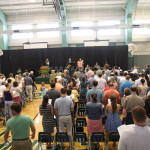
Lastly are a series of painted prints based on a window from the cathedral in Orvieto. They are a reminder of the realness we experience in worship. We congregate in a space, whether it is a cathedral or gym, and together become a visual example of the Church.

Window 4, linocut, acrylic, latex on paper, 8”x8”, 2007
Four years after my semester abroad I found myself again in Italy and inevitably back in Orvieto. This time, instead of climbing the tight winding stairs to the roof of the clock tower, I stumbled upon a gallery exhibit on its second floor. Here was a display of a dozen of Bruce Herman’s paintings. After just a short time I was able to identify my two panels, each with little glimmers of silver leaf shining through layers of colorful oil paint.

Bruce Herman, Second Adam, oil on wood with silver and gold leaf, polyptych, 125”x144”, http://bruceherman.com/
Here was our hard work, culminating years later in a powerful and moving exhibit. I was proud to be a part of the process, even though the entirety of my efforts with the silver leaf was not visible. Now I welcome process and layers into my work, as each layer makes the final product all the more rich. And just as the clock tower revealed itself to be more than just a set of stairs to climb, I desire for my work to inspire a deeper reflection into the intricacies of our relationship with Christ.
Sonya Berg Menges is a member of All Saints and works from her studio in North-Central Austin. She received a BA in Studio Art from Messiah College in Pennsylvania and her MFA from UT in 2010. Sonya will be showing a new body of work at Hill House about the nostalgia and perceived domesticity in tree house imagery, beginning April 29th. For more of her work, please visit www.sonyaberg.com.
Posted: March 29th, 2012 | Author: Greg Grooms | Filed under: Uncategorized | Tags: film | No Comments »
1) What are you thinking about as The Sunset Limited ends? First impressions are what we’re after here, not considered opinions. Spit out what’s on your mind without pausing too long to consider why it’s there.
2) One of the first images in TSL is the locked door of Black’s apartment. It’s an image that the director returns to more than once during the play. Why? What idea or feeling is reinforced by its repetition?
3) Early in their discussion Black tells White, “Belief ain’t like unbelief. If you’re a believer and you finally got to come to the well of belief itself, then you ain’t got to look no further. There ain’t no further. But the unbeliever’s got a problem. He’s set out to unravel the world. For everything he can point to that ain’t true, he leaves two false things laying there.” Discuss this quote. What is Black arguing here? Do you agree with him?
4) White saves one of his best points for late in the play, when he tells Black, “And brotherhood, justice, eternal life? Good God man… Show me a religion that prepares one for nothingness, for death. That’s a church I might enter. Yours prepares one only for more life, for dreams and illusions and lies. Banish the fear of death from men’s hearts and they wouldn’t live a day. Who would want this nightmare but for fear of the next. The shadow of the axe hangs over every joy. Every road ends in death, every friendship, every love. Torment, lost, betrayal, pain, suffering, age, indignity, hideous lingering illness… and all of it with a single conclusion. For you and everyone and everything you have ever chosen to care for.” Discuss this quote. What makes this this perspective attractive? In your opinion why does White want to persuade Black that this is so?
5) If you were in Black’s position, how might you have handled the encounter with White differently? At what points in the conversation would you have tried to take it in a different direction than Back did? Why?
6) Same questions as #5, but from White’s perspective. How might you have argued his case better than he did?
7) In several recent interviews Tommy Lee Jones said that The Sunset Limited reminds him of a Flannery O’Connor quote: “Faith is what someone knows to be true whether they believe it or not.” Discuss this quote and why in your opinion Mr. Jones ties it to The Sunset Limited
8 ) In your opinion who wins the argument between Black and White? Justify your answer.
9) The last image in TSL is, quite conspicuously and deliberately, a sunrise. What did it signify to you? Why do you think the director calls our attention to it?
Posted: February 24th, 2012 | Author: Greg Grooms | Filed under: Uncategorized | No Comments »

“To be, or not to be, that is the question…” Hamlet, Act 3, Scene 1.
I admit it: Cormac McCarthy fascinates me. Ever since I stumbled across No Country For Old Men in an airport bookstore seven years ago, I’ve savored every morsel of his writing, including his ten novels, two plays, and one screenplay. Three of his novels – All the Pretty Horses, No Country, and The Road—have made it to the screen so far, and both of his plays, albeit only on TV. Last year’s HBO production of his play The Sunset Limited is the subject of this review.
There are but two characters in TSL: Black, a poorly educated ex-con, played by Samuel L. Jackson, and White, a university professor played by Tommy Lee Jones. The play begins just after Black rescued White, who tried to commit suicide by throwing himself in front of a commuter train. Black takes White home to his shabby apartment, and the two spend the next hour and a half debating the meaning of life.
Black is a believer and argues simply but eloquently for the gospel. His approach to evangelism is the one I was taught years ago in the First Baptist Church of my home town: start by telling what Jesus has done for you. I’m sad to say it’s an approach that never worked well for me. At the time I felt this was due to the fact that my testimony is boring; there simply isn’t much drama in growing up white, middle-class and Baptist. Black’s story in contrast packs all the pop mine lacked. When White learns that Black has spent time in prison, he asks him to tell him a story about his time in the Big House. Black responds with a tale that my evangelism teachers would have been proud of: one day in the prison cafeteria he got into a fight with another inmate that produced two results: his salvation and permanent brain damage for his assailant. There are, of course, more details to the story than this, but trust me: you need to hear Samuel L. Jackson tell it, not me.
Unfortunately Black’s testimony isn’t any more persuasive than mine used to be. White just isn’t interested in what Jesus can do to improve his quality of life; offers of eternal life make him shudder. You see, existence itself is The Problem in his eyes. Is he an atheist? Sure, but that’s not why he tried to commit suicide. White’s dilemma is the Dilemma of the Secular Existentialist. On one hand, life is whatever you make of it, and you are free to do with it as you will. On the other, life is whatever you make of it, and if despite your best efforts, it doesn’t turn out well, why not end it all? Indeed, in his opinion this is the only honest choice available to anyone. In his words, “If people could see the world for what it truly is, see their lives for what they truly are without dreams and illusions, I don’t believe they could offer the first reason why they should not elect to die as soon as possible.”
Cormac McCarthy is a master at writing dialogue and it is the richness of his dialogue even more than the strength of his characters that carries TSL. If the idea of listening to an hour and a half of conversation sounds boring to you, think again. Conversation this good is rare, and if I had McCarthy writing my dialogues for me, I’d never tire of talking to anyone. Still like good food, dialogue this rich should be digested slowly, if at all possible. So if you have the time and the inclination, please get a copy of the play and read it before watching the movie. It’ll set the stage (no pun intended) for what follows. And if you’ve already read the play, please watch the film, too. Remember what it was like to read Shakespeare the first time? The beauty of the words, getting to know the characters, the delight of the story? It was good, wasn’t it? And then remember what it was like to see Much Ado About Nothing performed well, by real artists. If nothing else it brought home the simple fact that plays were meant to be performed, not just read. TSL is at its heart a play about whether or not life is worth living, and while you can learn a lot about Cormac McCarthy’s answers to that question by reading it, you’ll learn even more by watching.
The tagline on The Sunset Limited DVD reads, “Nothing is ever black or white.” I imagine it’s the product of an ad exec’s imagination rather than McCarthy’s for the predominant shades in all his work are back and white. He sees the world, rightly, as a world of sharp contrasts. Either we make choices and are responsible or our lives are ruled by fate. Either evil is real or all our tragedies are pointless. Either life is worth living or it isn’t. What’s hard to find amidst his black and whites is a clue to which he thinks is so.
I’ve read lots of reviews of the play and the movie. I’ve read the play out loud with friends, watched the film with them, and spent hours discussing both, and in our discussions I’ve noticed a consistent pattern. Believers think, “Our guy won. His arguments were better. He carried the day.” Secularists think the same things, but about White, not Black. I think that The Sunset Limited is a carefully balanced presentation of what McCarthy considers some of the best arguments each side has to offer. If so, in his mind it’s a tossup in the end. You make your choice and you place your bets. Everything is riding on your bet, but you can’t know if your bet was a good one until it’s too late. If I’m right, then The Sunset Limited begs an important question: not the one I started this review with–“To be or not to be”– but rather Pontius Pilate’s question to Jesus in John 18– “What is truth?”
And as Hamlet also said, “There’s the rub.” Living well without answers—the American Way– is a comfortable make-believe. As Dick Keyes once memorably put it, it’s like sailing first class on the Titanic: we go out in style. But having good answers that can’t be lived is no better. A belief in God that doesn’t translate into hope that existence has not always been and will not always be hell just isn’t attractive to White or anyone else I know. Fortunately, the gospel according to Jesus does just that, even if the gospel according to Cormac McCarthy does not.
Posted: February 21st, 2012 | Author: Tim Frickenschmidt | Filed under: Uncategorized | No Comments »
Tomorrow is Ash Wednesday and All Saints is offering two worship services so that, as a church, we may become more fully like the people spoken of by Jesus in his Beatitudes – “the poor in spirit,” “those who mourn,” “the meek”. But in order to worship well on Ash Wednesday, one has to understand the season of Lent. And to understand Lent one has to see it within the context of the entire Christian year. So we will consider the church calendar today in order to worship “in spirit and truth” tomorrow.
Eugene Peterson writes, “When we submit our lives to what we read in Scripture, we find that we are not being led to see God in our stories but our stories in God’s. God is the larger context in which our stories find themselves.” The practice of following the Christian calendar rests upon this fundamental conviction of which Peterson speaks – as Christians our lives are a part of a larger story that encompasses the entire world and its history.
This grand narrative is the biblical story, the Genesis-to-Revelation epoch, beginning with the Triune God creating all things from nothing out of his effusive joy, including mankind in his image. Following God’s creation comes man’s fall into sin where human beings rebel against God with ruinous consequences to themselves and the earth. But then God counters man’s sin by incarnating himself in the person of Jesus Christ. It is through Christ and his work that mankind, along with the physical creation, are redeemed. And all of this dramatic action finally culminates in a new heavens and earth where God’s people dwell, delighting in the glory of his presence. In Romans 1 the Apostle Paul call this story “the gospel of God,” the good news.
We should ask ourselves what story predominately shapes our lives. Some story does, whether that of romance and marriage, career advancement and wealth, physical health and beauty, some other story… or the Christian story. As followers of Christ, we need continual reminding that: “to embrace Jesus is to be reconciled to God and to consciously step into his Story. And to follow Jesus is to have the shape and purpose of our lives conformed to the shape and purpose of his…. In other words, we want to inhabit the still-unfolding Story of God and have it inhabit and change us.” (Bobby Gross, Living The Christian Year) The ancient liturgical habit of living the Christian year does just that- it acts as a continual reminder that Jesus’ story is now our story and should therefore be the primary formative influence in our lives.
In this quote from Bobby Gross, we are directed subtly toward the central Christian doctrine of union with Christ (that believers in Christ are united to him by faith and share in his death and life) and how it can be lived out practically through spiritual practice of following the church calendar. The Apostle Paul writes in Galatians 2:20: “I have been crucified with Christ. It is no longer I who live, but Christ who lives in me. And the life I now live in the flesh I live by faith in the Son of God, who loved me and gave himself for me.” For Paul, a Christian is someone whose death for sin has been endured already by Jesus and also someone into whose heart God’s life has exploded – the two have become one in “mystic sweet communion.” If we are to take this doctrine of union with Christ seriously and see it applied in all aspects of our life, then it makes sense to structure our corporate and individual lives of faith around Jesus’ life as he lived it on the earth.
This is what the church calendar is – a structured sequence of 6 seasons built around holy days that turn Christians’ attention in worship and daily life to the primary events in Jesus’ life: his birth, baptism and transfiguration, death, resurrection, ascension, and giving of the Spirit. The focus of each season calls us to mirror God’s movements in history in our worship and devotional practices – his waiting (Advent), giving (Christmas), telling (Epiphany), dying (Lent), rising (Easter), being poured out (Pentecost). In other words the goal of the church calendar is to, year after year, immerse Christ-followers’ hearts, bodies, and minds in the divine actions that have been undertaken on our behalf. Hopefully, as we respond in faith to this rehearsal of the redemptive acts of God in the life of Christ we will be drawn more fully into his life and conformed to his image.
So join us tomorrow in worship at Red River Church at noon or St. Gabriel’s school at 6 PM as we seek to step more fully into the Christ story and, together, live out our life in him.
-Tim